Almost everyone is at least partly familiar with the vital organs that are mentioned time and again on our favorite medical shows. The heart, the liver, the kidneys, the spleen, the… omentum?
The omentum??? What’s that?
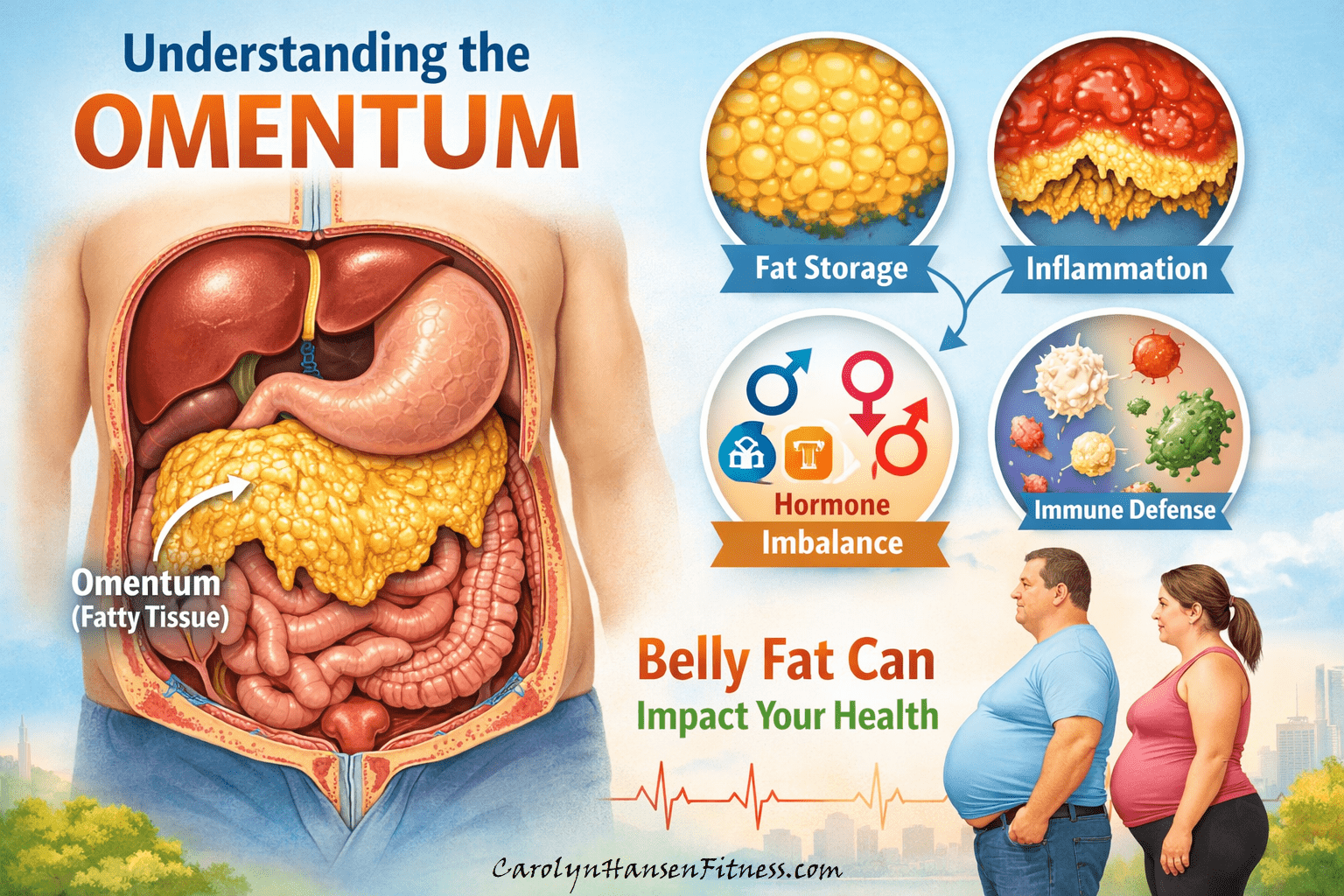
The omentum is an anatomical term that most people will have never been exposed to before. Measuring approximately 14 inches in length and 10 inches in width, this layer of fatty tissue that we call the omentum hangs down like an apron inside the abdomen.
It is positioned in front of the intestines but sits underneath the stomach muscles. The lower edge of this fatty mass goes down near the pelvis in the lower abdominal area. At its upper edge it is attached to the transverse colon which is located just below the stomach.
In appearance, the omentum looks a great deal like panty hose with wide webbing. But as you begin to become overweight, the organ grows larger as globules of fat fill up the spaces of the webbing. Also called the ‘lace apron’, the omentum drapes over the stomach area, but when it begins to clog with fat it becomes bunched up and clumped. It is at this point that an excessively large omentum becomes a ticking time bomb, releasing dangerous inflammatory chemicals into the bloodstream. These chemicals harm organs, and tissues in the abdomen, and set the stage for disease.
As one of the main fat reservoirs in the body, the omentum varies greatly in size depending of how much fat has accumulated within it. When swollen with deposited fat, the omentum is responsible for that well known ‘pot belly’ shape we love to make fun of, and it can be quite firm to the touch, not soft and marshmallowly like you might expect.
Until recently the omentum had been thought to be relatively inert tissue. But science is slowly revealing the secrets of the omentum, showing that it is actually dynamic tissue having many functions other than just the storage of fat.
This is one of the reasons belly fat should never be dismissed as just a cosmetic problem. What is happening around the waistline is often a visible sign of deeper imbalance taking place inside the body.
A growing belly is frequently the outward reflection of inflammation, hormone disruption and stress overload, all of which can quietly undermine health long before a diagnosis is ever made.
For example, the omentum provides both protective cushioning and structural integrity (acts as a kind of glue) for our internal organs. So it can be viewed as something of a safety net for the bits and pieces that make up the complex biology of the digestive system. Of course, some people have more protective cushioning than others – much more than they need, and much more than is healthy for them.
Unfortunately, it turns out that the fat cells inside the omentum do more than simply act as storage containers for harmless excess fat. A number of powerful chemicals are produced by cells in the omentum that actively disrupt the body’s metabolism and promote inflammation. This in turn sets the stage for killer diseases to take root, something that is all too common an occurrence in our modern day sedentary world.
Omentum and Inflammation –
It is this silent inflammatory process that makes excess abdominal fat so dangerous.
Unlike the fat that sits just under the skin, the fat associated with the omentum is metabolically active. In other words, it does not just sit there doing nothing. It sends messages throughout the body, and when those messages are inflammatory in nature they can interfere with normal healing, energy production and hormone balance.
No matter whether you happen to be male or female, a consequence of excess belly fat is the production of excess quantities of the female hormone estrogen. For a man, this is not good news. His “manliness” will begin to subside as female hormones override his ‘manly’ master hormone testosterone.
This higher than normal level of estrogen in an overweight man will change his body from one that is firm and muscular, to one that is flabby and depressed.
Women can’t escape their share of estrogen-induced ‘female’ problems either. These range from mildly irritating “discomforting” problems, to massively intrusive conditions such as breast cancer. Many women will gain belly fat once they pass the age of 30, and more than half of all women over the age of 35 years find themselves on a merry-go-round of hormone imbalances attributed to estrogen overload.
For women, these changes can creep in so gradually that they become accepted as normal. Weight gain around the middle, mood swings, poor sleep, fatigue and stubborn cravings are often brushed aside as just part of getting older. But very often they are signals that the body is struggling to maintain balance in the face of:
too much stress, too little movement and an overload of the wrong foods!
 Your Omentum and Stress –
Your omentum does more than ensure a tight waistband when you over indulge with food. It is chock-full of important nutrients and hormones that stimulate growth and repair.
It also contains stem cells, those valuable inherited genetic ‘blueprint’ or ‘ancestral’ cells that get scientists so excited with dreams of one day being able to grow life-giving body tissues and even entire body organs from them.
The omentum also plays an important role in disease prevention, and contains germ-fighting cells that attack infections in the abdomen and seal them off so they can do no harm to the delicate internal organs. Some experts have referred to the omentum as “the policeman of the abdomen.”
So while the omentum can certainly become part of the problem when overloaded with fat, it is not an organ we should think of as bad or useless. Like so much in the body, it has an intelligent purpose. The problem begins when we burden it beyond what it was designed to handle. Then the very tissue that was meant to protect us begins to contribute to decline.
When stress becomes the norm in our lives, rather than the exception, the stress hormones cortisol and adrenaline build up to excessive levels and our body has to find a way to cope with them. It is at this point that the ‘omentum’ kicks in, sucking up these circulating stress hormones like a blotter clearing the system.
Stress hormones stimulate the omentum to store more fat to dissipate and dilute those same hormones. The end result is stress stimulates the growth of that pot belly, which further increases your level of stress, leading to a kind of merry-go-around that is hard to get off.
This helps explain why so many people do not seem to lose belly fat easily, even when they are making some effort.
When the body remains stuck in a stress response, it is constantly being signaled to hold on, store more and protect itself. That is why restoring health is not just about eating less.
It is also about calming the nervous system, moving the body regularly and giving the body a reason to feel safe enough to let go.
While that growing pot belly of yours might be spoiling your physical appearance, what it is doing to your insides is far more dangerous. It is basically poisoning you, and setting you up for a chronic condition known as ‘metabolic syndrome’. When metabolic syndrome takes root things begin to go haywire. Hormones, blood sugars, and fats become unbalanced, and the risk of heart attack, stroke and other serious diseases increases.
Most people aged between 35 and 45 years are at risk of developing metabolic syndrome, and the principal means by which this condition can be avoided is to reduce belly fat.
So what can you do?
The first thing would be to assess your current risk. A simple blood test can tell you a great deal. If you discover that your vital statistics are outside the normal range (as discussed below) you will know that it is time to make some changes to your lifestyle, such as to incorporate a sensible exercise regime and develop healthy eating habits.
The good news is that the body is always trying to move back toward balance when we begin to support it. Even modest weight loss, better food choices, daily walking and lower stress levels can begin to reduce the burden on the omentum and improve the health of the whole body. Small changes done consistently are often far more powerful than short bursts of extreme effort.
Here are some of the tell-tale signs of metabolic syndrome:
• Waist measurement larger than 35 inches for women, and 40 inches for men
• Blood pressure higher than 130/85
• HDL cholesterol (good cholesterol) lower than 40 for women and 50 for men
• Triglyceride (blood fat) level higher than 150
• Blood sugar higher than 100 after fasting
The omentum may not be as famous as the heart or liver, but it plays a surprisingly important role in your health. When it is healthy it helps protect, repair and defend the body. But when it becomes overloaded with fat, stress and inflammation, it can become a major contributor to illness. That is why paying attention to belly fat is not about vanity. It is about protecting your metabolism, your hormones, your organs and your future health. The message is simple: take care of your body before it is forced to get your attention the hard way.
Isn’t it time to focus on you! To finally address all those health and fitness issues you’ve been putting off?
Everything you need to discover and live the best life possible can be found at:
Self=Improvement Gifts a Library of Free resources that help with all your health and fitness goals.